Key Takeaways
- Psychological difficulties emerge from self-reinforcing brain–behavior patterns.
- Brain networks, learning experiences, and environment interact continuously.
- Therapy works as a structured learning process that restores flexibility.
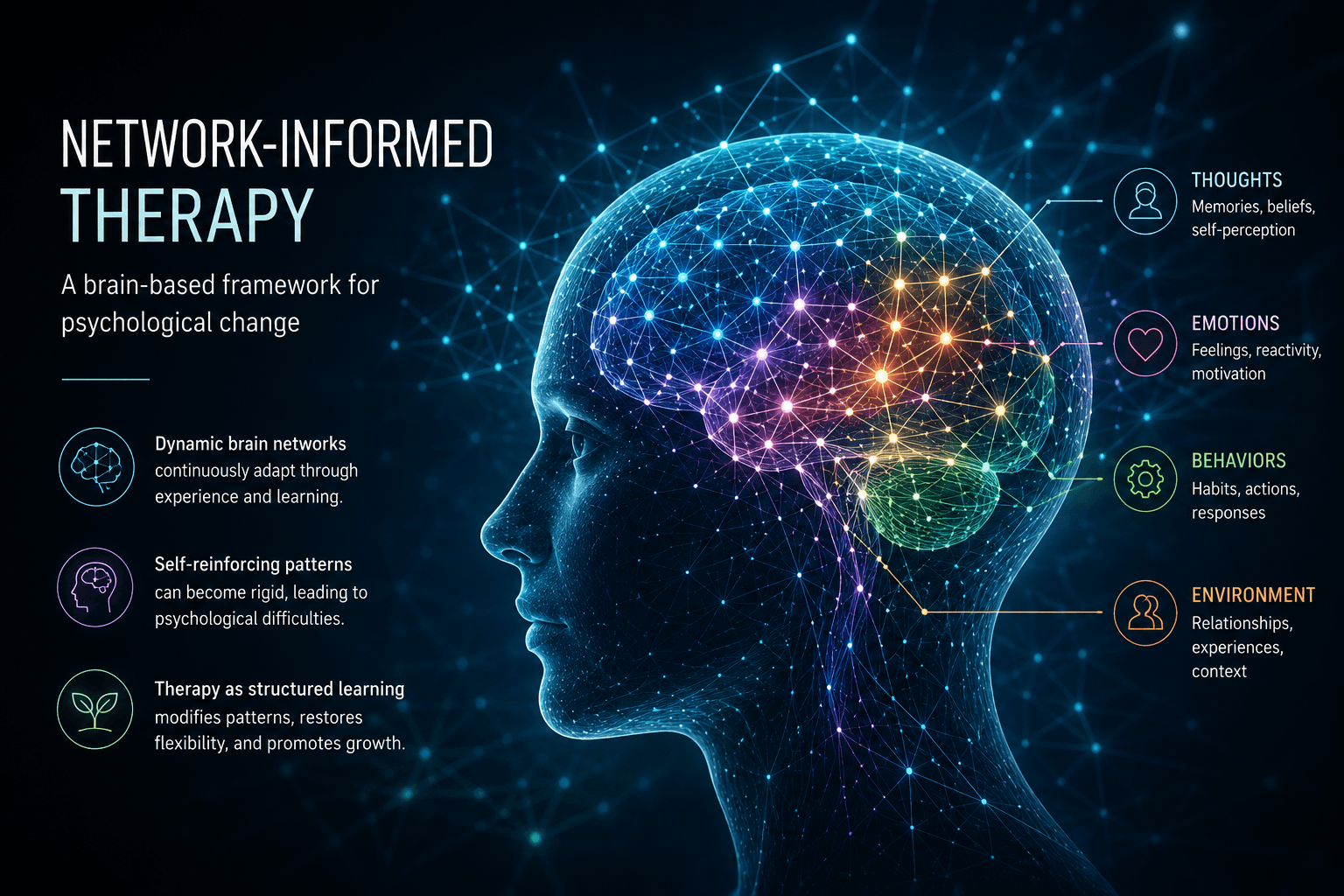
Mental health difficulties are often described as disorders that people have. A brain-informed, network-based perspective offers a different view: rather than conceptualizing problems as discrete diagnostic entities, this model views psychological difficulties as patterns that emerge from interactions between brain networks, learning experiences, and environmental influences — arising from a dynamic, self-organizing system shaped by biological constraints, environmental inputs, and learning processes.
Why a Network-Based Framework Matters
Contemporary neuroscience shows that cognition, emotion, and behavior arise from distributed systems rather than isolated brain regions. Large-scale brain networks such as the Default Mode Network, Salience Network, and Central Executive Network have been shown to underpin core psychological processes including self-referential thinking, attentional allocation, and cognitive control. At the same time, psychological science highlights the role of learning and reinforcement, developmental experience, cognitive schemas, and behavioral conditioning. Despite these advances, a gap often remains between neuroscientific knowledge and practical psychological formulation — this framework addresses that gap.
The Brain as a Self-Organizing System
The brain is conceptualized as a dynamic, adaptive system that continuously reorganizes itself through neuroplasticity in response to internal and external inputs. Human functioning emerges from network interactions, feedback loops, and experience-dependent learning. Rather than being fixed, these systems adapt continuously.
Biological Sensitivity and Environmental Influence
Individual differences in functioning reflect baseline system biases, including emotional reactivity, attentional control capacity, and arousal regulation. These are influenced by genetic and developmental factors but are not deterministic — aligning with the Diathesis-Stress Model, which posits that outcomes arise from the interaction between vulnerability and environmental input. Environmental experiences including early attachment, caregiving, social and educational experiences, reinforcement contingencies, and stress function as learning signals that shape how the system interprets information, regulates internal states, and generates responses.
Psychological difficulties are not fixed disorders, but self-reinforcing patterns within a dynamic brain–behavior system.
How Patterns Form
Through repeated activation and reinforcement, the system develops stable configurations — including habits, emotional response patterns, and cognitive schemas. These configurations reflect learned network organization rather than isolated cognitive constructs. Over time, these patterns become the default modes through which the individual perceives and responds to the world.
Adaptive and Maladaptive Functioning
In adaptive functioning, network interactions are flexible, patterns are modifiable, and responses are context-sensitive. The system can update predictions, regulate emotional responses, and shift between internal and external focus. Psychological difficulties arise when patterns become over-reinforced and flexibility is reduced, resulting in repetitive cognitive-emotional cycles, biased perception and interpretation, and restricted behavioral repertoires. Crucially, the system is not "damaged" — it is over-efficient at reproducing previously learned patterns.
Resilience as System Flexibility
Not all individuals with biological sensitivity develop difficulties. Protective factors include supportive relational environments, adaptive learning experiences, and the development of strong regulatory capacities. Resilience can therefore be understood as the system's capacity to maintain flexibility under stress — the ability to adapt while preserving functional balance.
From Diagnosis to Formulation
This framework supports a shift from symptom-based description to system-based formulation. Key formulation questions include: What patterns are dominant? Where is flexibility reduced? What feedback loops maintain the system in its current state? How do brain, behavior, and environment interact to sustain the difficulty?
Therapy as Structured Learning
Psychological intervention can be understood as a structured learning process designed to modify maladaptive, self-reinforcing patterns within the brain–behavior system. Through mechanisms of neuroplasticity, therapy introduces new experiences that disrupt existing reinforcement loops and facilitate the development of more adaptive patterns.
Rather than functioning solely as a means of insight generation, therapy operates as an experiential learning environment in which individuals actively acquire new ways of perceiving, responding, and regulating. This includes updating predictive and interpretive models (schemas), modifying behavioral responses and reinforcement contingencies, and enhancing attentional and regulatory capacities. The therapeutic relationship itself provides a controlled, supportive context that enables safe exposure to previously avoided experiences, thereby accelerating learning and promoting generalization to real-world settings.
Designing Interventions Across Multiple Levels
Effective intervention may target multiple parts of the system simultaneously. At the network level, this includes attention and regulation training and neurofeedback where appropriate. At the cognitive level, schema restructuring and cognitive flexibility training address interpretive biases. At the behavioral level, disrupting reinforcement loops, exposure, and behavioral activation challenge established patterns. At the environmental level, modifying relational and contextual inputs enhances adaptive feedback and supports lasting change.
Implications for Modern Psychological Practice
Each individual represents a unique combination of biology, learning history, and environmental experience. As a result, interventions must remain adaptive, personalized, and responsive to continuous feedback — outcomes are non-linear, and the process is iterative. This model is not a replacement for existing therapies, but a framework for integration, enhancing case formulation, treatment planning, and outcome monitoring.
Conclusion
A network-based understanding of psychological functioning suggests that mental health difficulties arise from over-stabilized patterns shaped by brain networks, learning processes, and environmental influences. By restoring flexibility within these systems, psychotherapy can facilitate meaningful and lasting change.
Psychological difficulties are not fixed disorders, but self-reinforcing patterns within a dynamic brain–behavior system — patterns that can be understood, modified, and reorganized through targeted, informed intervention.